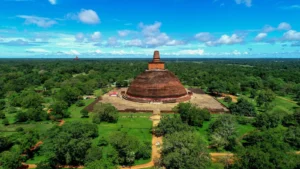
The cultural triangle in Sri Lanka is home to some of the world’s oldest hydraulic cities. Long before modern engineers coined the term “sustainable urban planning,” Sinhalese kings were building reservoirs, canals, and forest cover into the bones of their cities. Anuradhapura, Polonnaruwa, and Sigiriya were not just political capitals, they were water-managed, climate-conscious green cities. This article looks at how that ancient system worked, why it still matters, and how many days you need in the cultural triangle Sri Lanka region to see it properly.
What is the Cultural Triangle in Sri Lanka?
The cultural triangle in Sri Lanka is the historic zone connecting Anuradhapura, Polonnaruwa, and Kandy, with Sigiriya and Dambulla usually included as key stops inside it. It covers roughly 2,000 years of continuous urban history, and it holds six UNESCO World Heritage Sites within a fairly compact area of the island’s dry zone.
Most travellers come for the ruins, the frescoes, and the rock fortress views. Fewer arrive knowing that the ground beneath those ruins hides one of the most advanced water management systems of the ancient world. The cities of the cultural triangle were built around what historians now call “tank cascade systems,” networks of interconnected reservoirs designed to catch monsoon rain and release it slowly across the dry season.
This wasn’t a lucky accident of geography. It was deliberate civil engineering, refined over centuries, and it turned an unforgiving dry zone into farmland that fed entire kingdoms.
The Hidden Eco-Engineering Behind the Ruins
Sri Lanka’s dry zone gets most of its rain in short, intense bursts during the north-east monsoon, followed by long stretches with almost none. Ancient Sinhalese engineers solved this with a cascading network of tanks (locally called wewa), linked by canals so that overflow from one reservoir fed the next one downstream.
A few features made the system remarkable:
- Bisokotuwa (valve towers): Sluice structures built into dam walls that released water at controlled pressure, preventing erosion, an idea Western engineering wouldn’t formalise until centuries later.
- Forest buffers: Strips of natural forest were deliberately preserved around catchment areas to reduce runoff and protect water quality.
- Cascading reservoirs: Smaller village tanks fed into larger royal tanks, which fed into the city’s core, so almost no rainfall in the catchment was wasted.
- Integrated city planning: Anuradhapura’s layout placed reservoirs like Tissa Wewa and Basawakkulama Wewa directly alongside temples, palaces, and residential quarters, treating water infrastructure as part of the city’s identity, not something hidden underground.
| Ancient City | Key Water Structure | Approx. Era |
|---|---|---|
| Anuradhapura | Basawakkulama Wewa | 4th century BCE |
| Anuradhapura | Tissa Wewa | 3rd century BCE |
| Polonnaruwa | Parakrama Samudra | 12th century CE |
| Sigiriya | Water gardens & moats | 5th century CE |
King Parakramabahu I, who built the Parakrama Samudra (“Sea of Parakrama”) at Polonnaruwa, is credited with a saying that still gets quoted by Sri Lankan engineers today: not one drop of rainwater should reach the sea without first serving humanity. Whether or not the phrasing is exact, the philosophy behind it clearly shaped how these cities were built.
Why These Ancient Green Cities Still Matter Today
Modern urban planners studying drought-prone regions have started looking back at these tank cascade systems for answers. Sri Lanka’s dry zone tanks are now recognised internationally as an early, functioning model of what today would be called climate-resilient infrastructure. Some of these ancient reservoirs are still in active agricultural use, more than a thousand years after they were built.
That’s a fairly extraordinary track record for any piece of infrastructure, ancient or modern. Walking around Tissa Wewa in the early morning, watching farmers still drawing on a system designed under a king who died over 2,000 years ago, gives the ruins a different weight than most people expect.
How Many Days Do You Need in the Cultural Triangle Sri Lanka?
A reasonable minimum is 3 to 4 days, giving one full day each to Anuradhapura, Polonnaruwa, and Sigiriya with Dambulla, without rushing the sites. Travellers who want to properly explore the reservoirs, cycle around the tank bunds, and add Kandy at the end of the loop should plan closer to 5 to 6 days. Anuradhapura alone rewards a slower pace, since many of its most interesting water structures are spread across a wide archaeological zone best covered by bicycle or tuk-tuk.
What is the Best Time to Visit the Cultural Triangle Sri Lanka?
The best time to visit the cultural triangle Sri Lanka is between May and September, during the island’s dry season on this side of the country. Roads are easier, the ancient tanks are visibly at work irrigating surrounding paddy fields, and early morning light on Sigiriya rock is at its best. The shoulder months of March, April, October, and November are also workable, with fewer crowds, though short showers are more likely.
Planning a Cultural Triangle Tour with Local Insight
Seeing the ruins is one thing. Understanding why they were built where they were, and how the water system tied an entire kingdom together, is what turns a day of sightseeing into something worth remembering. A well-guided cultural triangle tour in Sri Lanka usually threads together Anuradhapura’s ancient tanks, Polonnaruwa’s Parakrama Samudra, and Sigiriya’s water gardens in a logical route, rather than backtracking across the dry zone.
For travellers who want to go beyond the standard itinerary, it’s worth building in time at the lesser-visited cultural heritage sites scattered around the triangle, many of which still show traces of the smaller village-level tanks that fed into the larger royal reservoirs.
Frequently Asked Questions
What is the cultural triangle in Sri Lanka? The cultural triangle in Sri Lanka is the historic region linking Anuradhapura, Polonnaruwa, and Kandy, home to ancient royal capitals, cave temples, and six UNESCO World Heritage Sites. It’s considered the cultural and archaeological heart of the country.
How many days do I need for a cultural triangle tour in Sri Lanka? Most travellers need 3 to 4 days for the core sites, or 5 to 6 days for a fuller loop that includes Kandy. Anuradhapura and Polonnaruwa each benefit from a full day due to how spread out their ruins and reservoirs are.
Why were ancient Sri Lankan cities built around water tanks? Sri Lanka’s dry zone has short, heavy monsoon rains followed by long dry spells, so ancient rulers built cascading reservoir systems to store and distribute water year-round. These tank cities allowed large populations to farm and live in an otherwise arid region.
Is Sigiriya part of the cultural triangle? Yes, Sigiriya sits within the cultural triangle alongside Dambulla, and its water gardens and moat system are considered some of the most advanced landscape engineering of the ancient world.
When is the best time to visit the cultural triangle in Sri Lanka? The best time to visit is May to September, during the dry season in this part of the island, when roads and ruins are easiest to explore. Shoulder months like April and October are also good options with fewer crowds.